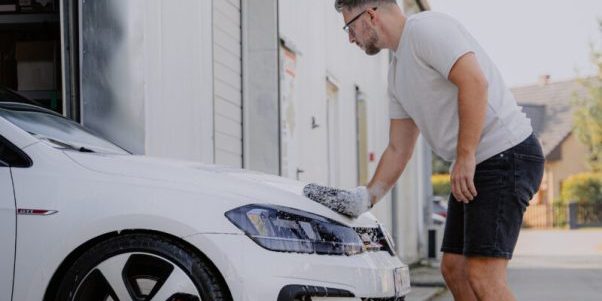
Pre-washing plays an important role in a safe car wash. It helps remove loose dirt, traffic film and road grime before you touch the paintwork, reducing the risk of introducing swirl marks and scratches during the contact wash.
Whether you use a snow foam lance, pump sprayer or dedicated pre-wash product, getting this stage right can make a noticeable difference to your results.
In this guide, we’ll explain how to pre-wash a car properly, compare popular products and share techniques to help you achieve the best possible clean.
What Is a Car Pre-Wash?
A pre-wash involves cleaning your vehicle before physically touching the paintwork with a wash mitt or sponge.
During everyday driving, your car collects a mixture of contaminants, including:
- Road grime and traffic film
- Mud and loose dirt
- Dust and environmental contamination
- Insects and organic deposits
- Oily residues from the road
A simple rinse with water won’t always remove these contaminants. A suitable pre-wash product helps loosen and lift dirt so you can rinse away more contamination before the contact wash.
The main benefit is reducing the amount of abrasive dirt left on the paintwork when you begin washing by hand.
Snow Foam vs Traffic Film Remover: What’s the Difference?
Snow foam and traffic film remover (TFR) both help clean your vehicle before the contact wash, but they don’t necessarily work in the same way.
Snow Foam
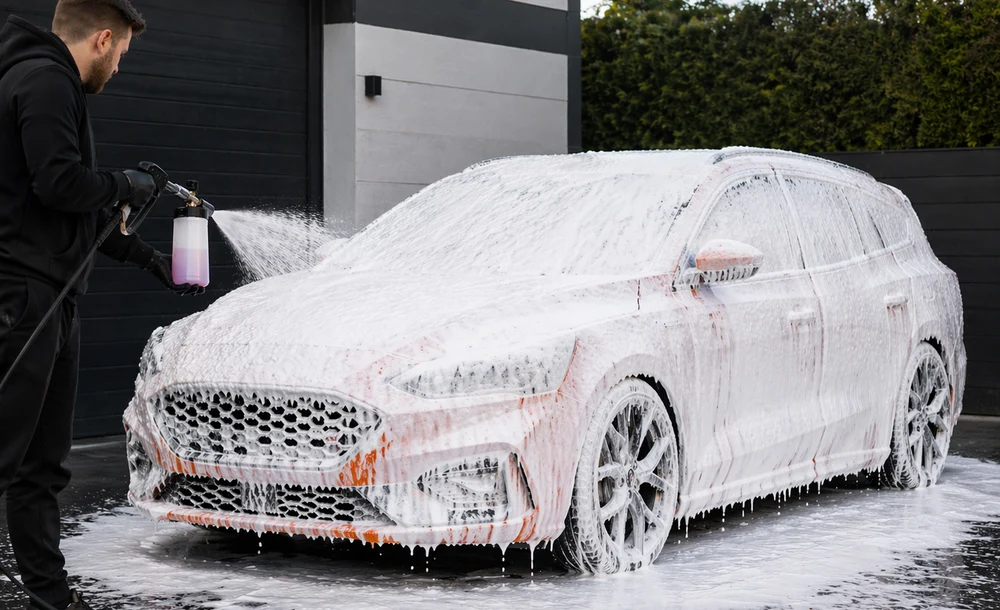
Snow foam clings to the vehicle’s surfaces, giving its cleaning agents time to work on dirt and contamination.
Detailers commonly apply it using a pressure washer and foam lance, although some products also work in a pump sprayer.
Snow foam can be particularly useful for regular maintenance washing, especially when your vehicle isn’t heavily soiled.
Traffic Film Remover
Traffic film removers tackle more stubborn road contamination. Depending on the formulation, they can break down the greasy film that builds up through everyday driving.
Some dedicated pre-wash products deliver strong cleaning performance without requiring aggressive contact washing.
Your choice should depend on how dirty the vehicle is and the product’s intended use.
How to Pre-Wash a Car Properly
Following the correct process matters just as much as choosing the right product.
Step 1: Work on Cool Paintwork
Whenever possible, wash your vehicle in the shade and avoid applying chemicals to hot paintwork.
Warm panels can cause cleaning products to dry too quickly, potentially leaving residue or water marks.
Step 2: Rinse Off Loose Dirt
Start by rinsing the vehicle with a pressure washer or hose.
Pay particular attention to the wheel arches, lower doors, bumpers and rear of the vehicle, where dirt tends to accumulate.
This initial rinse removes loose grit before you apply your pre-wash chemical.
Step 3: Apply Your Pre-Wash Product
Apply your chosen product evenly across the vehicle, following the manufacturer’s instructions.
Work from the lower sections upwards if the product instructions recommend this approach.
Allow the product to dwell for the recommended time, but never let it dry on the paintwork.
Step 4: Allow the Product to Work
Dwell time gives the cleaning agents an opportunity to loosen and break down contamination.
There isn’t one universal dwell time for every product. Temperature, weather conditions, dilution and the level of contamination can all affect how long a product should remain on the vehicle.
Always follow the manufacturer’s instructions and adjust your approach to suit the conditions.
Step 5: Rinse Thoroughly
Use a pressure washer to rinse the vehicle thoroughly, working from the top down.
Pay attention to panel gaps, badges, trims and other areas where residue can collect. Make sure you remove all traces of the pre-wash product.
Step 6: Move on to the Contact Wash
Once you’ve completed the pre-wash, move on to your regular contact wash using a suitable car shampoo and clean wash mitt.
The pre-wash won’t necessarily remove every contaminant, but it should reduce the amount of dirt left on the surface before you touch the paintwork.
Best Car Pre-Wash Products to Consider
You’ll find plenty of pre-wash products on the market, but a few established detailing brands deserve consideration.
Bilt Hamber Touch-Less
Bilt Hamber Touch-Less is a concentrated, touchless pre-wash designed to remove traffic film and road grime.
Its cleaning performance makes it particularly useful if you want to remove as much contamination as possible before the contact wash.
One important point to understand is its Panel Impact Ratio (PIR). The PIR refers to the concentration of product reaching the vehicle, rather than simply the dilution ratio inside your foam lance bottle.
Bilt Hamber explains the product’s application and dilution method on its official Touch-Less product page.
You can also read our full Bilt Hamber Touch-Less review for a closer look at its performance.
Bilt Hamber Auto Foam
Bilt Hamber Auto Foam is another popular option for pre-washing.
The product helps loosen and remove road contamination before the contact wash. Its cleaning performance makes it worth considering for regular maintenance and more demanding cleaning jobs.
Correct dilution plays an important role in achieving the expected results. Follow the manufacturer’s guidance and account for the dilution introduced by your application equipment.
For more information, visit the official Bilt Hamber Auto Foam product page.
Bilt Hamber also provides additional advice in its Auto Foam application and dilution FAQs.
For a closer look at its performance, read our Bilt Hamber Auto Foam review.
Koch-Chemie Gentle Snow Foam (GSF)
Koch-Chemie Gentle Snow Foam is a pH-neutral cleaning foam designed for vehicle washing.
Unlike some stronger pre-wash products, GSF suits regular maintenance washing and can form part of a wider car washing routine.
Consider it if you want a gentle snow foam from an established detailing manufacturer.
You can find product information and application recommendations on the official Koch-Chemie Gentle Snow Foam page.
We’ve also published a more detailed Koch-Chemie Gentle Snow Foam review.
Understanding Pre-Wash Dilution Ratios
Getting the dilution right is essential. A mixture that’s too weak may not deliver the cleaning performance you expect, while using a stronger mixture than recommended can waste product and potentially cause problems.
There are two measurements worth understanding:
Bottle dilution: This describes the ratio of product to water inside your foam lance bottle or pump sprayer.
Panel Impact Ratio (PIR): This describes the concentration of product that actually reaches the vehicle’s surface.
These measurements aren’t interchangeable. A foam lance mixes the contents of its bottle with additional water as it applies the product, so the concentration reaching the paintwork differs from the concentration inside the bottle.
For this reason, always check the manufacturer’s specific dilution instructions for your equipment. Bilt Hamber provides useful examples of this calculation in its Touch-Less application instructions and Auto Foam technical guidance.
If you’re using Koch-Chemie Gentle Snow Foam, its official product recommendations also provide guidance for foam sprayer and hand-washing applications.
Can You Use All-Purpose Cleaner as a Pre-Wash?
An all-purpose cleaner (APC) can help remove heavier contamination from certain exterior surfaces.
Products such as Koch-Chemie Green Star offer versatile cleaning performance and allow you to adjust the dilution for different applications.
However, an APC shouldn’t automatically replace a dedicated pre-wash product. Its suitability depends on the surface, dilution and intended use.
Always follow the product instructions and check compatibility before applying it to unfamiliar surfaces.
You can read our Koch-Chemie Green Star review to learn more about the product, or use our Koch-Chemie Green Star dilution guide to understand its different applications.
Common Pre-Wash Mistakes to Avoid
Even a good product won’t deliver the best results if you use it incorrectly.
Here are five common mistakes to avoid:
1. Applying products to hot paintwork
Hot panels can cause cleaning products to dry too quickly. Work in the shade wherever possible.
2. Allowing products to dry
Never let pre-wash chemicals dry on the vehicle. Follow the recommended dwell time and rinse thoroughly.
3. Using the wrong dilution
Adding more product doesn’t always improve cleaning performance. Follow the manufacturer’s instructions and account for your application equipment.
4. Skipping the initial rinse
Remove loose dirt first to reduce unnecessary contamination during the rest of the wash.
5. Expecting snow foam to do everything
Pre-wash products help reduce contamination, but they won’t necessarily remove every deposit. You still need a proper contact wash in most cases.
How Often Should You Pre-Wash Your Car?
For most vehicles, pre-washing should form part of every regular wash.
Your washing frequency will depend on how you use the vehicle.
A daily driver covering long motorway journeys will usually collect more traffic film than a vehicle you only use occasionally in dry weather.
During winter, wet and dirty roads make a good pre-wash particularly important.
The aim is simple: remove as much contamination as possible before touching the paintwork.
Frequently Asked Questions
Is snow foam enough to clean a car?
Snow foam can remove a surprising amount of loose dirt and road contamination, but it won’t necessarily clean every surface completely.
A contact wash is generally still required to achieve a thorough clean.
Should I pre-wash before using car shampoo?
Yes. Pre-washing helps remove loose dirt and traffic film before you use a wash mitt, reducing the chance of dragging abrasive contamination across the paintwork.
Can I pre-wash without a pressure washer?
Yes. You can use a suitable pump sprayer to apply a pre-wash product and rinse with a garden hose.
A pressure washer makes the process easier, but you don’t need one to pre-wash your vehicle.
Should I apply snow foam to a wet or dry car?
This depends on the product. Some manufacturers recommend applying their products to dry panels, while others allow application to wet surfaces.
Always check the manufacturer’s instructions before use.
Is traffic film remover safe for car paint?
A suitable automotive traffic film remover can safely clean paintwork when you use it as directed.
Always follow the recommended dilution and dwell time, and never allow the product to dry on the vehicle.
Final Thoughts
Pre-washing is one of the easiest ways to improve your car washing routine and reduce the risk of introducing scratches and swirl marks.
Choosing a suitable product, using the correct dilution and allowing it to work before rinsing can make a significant difference.
For regular maintenance washing, a quality snow foam may be all you need. If you’re dealing with heavier traffic film and road grime, a dedicated touchless pre-wash such as Bilt Hamber Touch-Less may be worth considering.
Ultimately, choose the right product for the level of contamination and follow the manufacturer’s instructions.
A good pre-wash won’t replace a proper contact wash, but it can make that next stage safer and more effective.
